Guttering Installers - Professional Gutter Installation and Replacement for UK Properties
Guttering installers provide an important property-maintenance service by ensuring rainwater is collected from roofs and directed safely away from buildings. Properly designed gutters and downpipes help protect external walls, roof edges, foundations and surrounding areas from uncontrolled rainwater.
For homeowners, landlords, freeholders, property managers and investors, damaged or poorly installed guttering can lead to overflowing water, damp staining and deterioration of building fabric. Professional installation should therefore consider roof area, drainage capacity, outlet positions, downpipes and the overall rainwater-disposal system rather than treating gutters as a purely decorative feature.
Fraser Bond supports UK property owners with property management, maintenance coordination, sales, lettings and wider real estate services through FraserBond.com.
What Do Guttering Installers Do?
Professional guttering installers fit, replace and repair the systems that collect rainwater from a building's roof.
Work can include removing deteriorated gutters, installing new sections, replacing brackets and joints, fitting downpipes, adjusting gutter falls and connecting rainwater pipes to suitable drainage arrangements.
Installers may also work alongside roofers where fascia boards, soffits, roof coverings or eaves require attention.
The Building Regulations require adequate provision for carrying rainwater from a building's roof. Approved Document H provides supporting guidance for rainwater drainage design. Legislation.gov.uk
New Gutter Installation
New guttering may be required during property construction, an extension, roof replacement or substantial refurbishment.
A correctly designed system needs sufficient capacity for the roof area it serves.
Gutters should direct water towards suitable outlets rather than allowing water to remain trapped within the system.
Government guidance states that gutters should be arranged with falls towards appropriate outlets and that overflow should be directed clear of the building to reduce the risk of rainwater entering or overloading the structure. GOV.UK
Gutter Replacement
Complete replacement may become appropriate when an existing gutter system has deteriorated beyond economical repair.
Repeated leaking joints, extensive corrosion, cracking, distortion and poorly supported sections can indicate that replacement offers better long-term value than continuing with individual repairs.
Replacement also creates an opportunity to assess whether the original gutter capacity remains suitable for the building.
This can be particularly useful where extensions or roof alterations have increased the amount of rainwater reaching a particular gutter.
Gutter Repairs
Not every gutter problem requires complete replacement.
Localised problems can often be repaired.
Typical defects include leaking joints, loose brackets, disconnected downpipes and sections that have moved out of alignment.
However, the underlying cause should be established. A gutter that repeatedly overflows despite being clean may be undersized, incorrectly positioned or connected to insufficient drainage.
UPVC Guttering
UPVC is widely used for residential gutter installations.
It is relatively lightweight and available in numerous profiles, including half-round, square and deep-flow systems.
Individual sections can also usually be replaced without removing the entire system.
Installation quality remains important. Poor bracket spacing, incorrect falls or inadequately sealed joints can compromise an otherwise suitable guttering product.
Aluminium Guttering
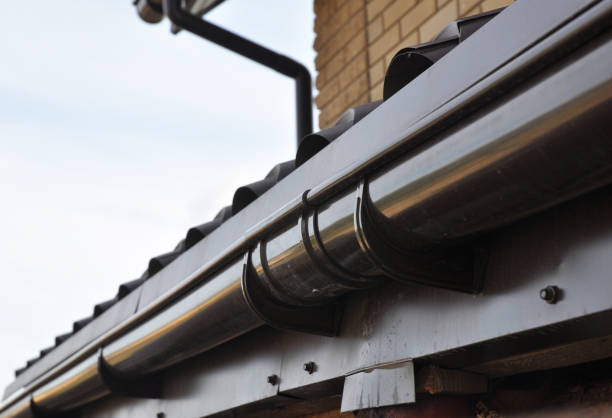
Aluminium guttering can provide a durable alternative for residential, commercial and higher-value properties.
Different profiles and finishes allow it to complement both contemporary and traditional architecture.
Aluminium systems may also appeal where owners want a more substantial appearance than conventional plastic guttering.
The suitability of any system should nevertheless be determined by drainage requirements rather than appearance alone.
Cast-Iron Guttering
Cast-iron gutters remain an important feature of many period and historic properties.
They can be particularly appropriate where maintaining original architectural character is important.
However, cast iron requires suitable maintenance because corrosion can eventually affect joints and sections.
Replacement on listed buildings or architecturally sensitive properties should be considered carefully where the original guttering forms part of the building's historic character.
Deep-Flow Guttering
Deep-flow systems provide greater water-carrying capacity than some standard residential profiles.
They may be useful where a large roof area drains into a relatively limited number of outlets.
However, selecting a larger gutter should not substitute for proper drainage design.
Roof area, rainfall, outlet capacity and downpipe arrangements should all be considered when specifying the system.
Downpipe Installation
Gutters and downpipes need to operate as a complete system.
Approved Document H states that a rainwater pipe should be at least as large as the gutter outlet it serves. Where one downpipe receives water from multiple gutters, it needs sufficient capacity for the contributing roof areas. GOV.UK
Downpipes also need to discharge appropriately.
Government guidance provides for rainwater pipes to discharge into appropriate drainage arrangements and includes provisions for situations where water is discharged onto another roof or drained surface. GOV.UK
Guttering for Flat Roofs
Flat roofs can require different drainage arrangements from conventional pitched roofs.
Outlets, parapet gutters, internal drainage and overflow provisions may all form part of the design.
Approved Document H notes that additional outlets can be necessary on flat roofs, valley gutters and parapet gutters to manage overflow safely. GOV.UK
This is particularly relevant to apartment buildings, extensions and commercial properties with substantial flat-roof areas.
Guttering for Pitched Roofs
Pitched roofs normally direct water towards gutters positioned along the eaves.
The gutter needs to be aligned correctly with the roof covering so that rainwater enters the system rather than passing behind or overshooting it.
Roof pitch, roof area and gutter profile can all influence performance.
Where a roof has recently been replaced, the guttering should be inspected as part of the project rather than automatically retaining an inadequate or deteriorated system.
Guttering for Period Properties
Traditional properties may have cast-iron, metal or architectural guttering that contributes to the external appearance of the building.
Replacement with an inappropriate profile can noticeably change the façade.
Owners of listed buildings or properties within conservation areas should therefore consider whether original guttering should be repaired or replaced with a visually appropriate system.
A specialist installer may be preferable where traditional materials or unusual architectural details are involved.
Guttering Installers for Landlords
Landlords should include gutters and downpipes within routine exterior maintenance.
Blocked or damaged guttering can allow water to run down external walls and contribute to damp-related problems.
Regular inspection can be particularly useful for rental properties surrounded by mature trees, where leaves and other debris can accumulate quickly.
Professional property management can help coordinate gutter inspections, cleaning and repairs alongside broader roof and exterior maintenance.
Guttering for Apartment Blocks
Apartment buildings can contain extensive rainwater systems serving large roof areas.
Maintenance responsibility will normally depend on the lease and building ownership structure.
Freeholders, Residents Management Companies and Right to Manage companies may need to arrange inspection, cleaning, repair and eventual replacement of communal gutters and downpipes.
Access can make these projects more complicated because scaffolding, mobile access equipment or other specialist arrangements may be required.
Commercial Guttering Installers
Commercial buildings often have substantially larger roof areas than houses.
Warehouses, retail buildings, offices and industrial property may therefore require higher-capacity gutters and downpipes.
Failure can create significant volumes of uncontrolled rainwater.
Commercial owners should consider planned inspection and maintenance, particularly around outlets where debris can restrict drainage.
Gutter Cleaning and Maintenance
Even correctly installed guttering requires maintenance.
Leaves, moss and other debris can obstruct gutters and outlets.
Standing water can then increase loads on brackets and cause overflowing during heavy rainfall.
Regular cleaning also provides an opportunity to identify deteriorating joints, corrosion, cracked sections and loose fixings.
Owners should avoid unsafe DIY access where gutters are difficult to reach and use appropriately equipped contractors when necessary.
Overflowing Gutters
Overflow does not always mean the gutter simply needs cleaning.
Possible causes include blocked outlets, insufficient downpipe capacity, poor gutter falls, inadequate gutter size or excessive water being directed into one section.
A competent installer should establish the cause before recommending replacement.
Repeatedly cleaning a fundamentally undersized system will not correct a capacity problem.
Leaking Gutter Joints
Leaks frequently develop around joints between gutter sections.
A local repair may be sufficient where the remaining installation is sound.
However, widespread leaking can indicate an ageing system or poor original installation.
Government technical guidance states that gutter joints should remain watertight under working conditions and that gutters and rainwater pipes should be firmly supported while allowing appropriate thermal movement. GOV.UK
Guttering and Fascias
Gutter brackets are commonly associated with fascia boards at roof level.
If timber fascia has deteriorated, simply attaching new guttering to it may not provide a durable installation.
Installers should therefore assess the condition of supporting components.
Where fascias and soffits require replacement, coordinating the work with the gutter installation can avoid duplicating access and labour costs.
Guttering and Roof Replacement
Roof replacement provides an appropriate opportunity to assess the existing rainwater system.
New roof coverings, extensions or alterations can change how water reaches gutters.
Existing guttering may also be approaching the end of its useful life.
Coordinating roofing and gutter replacement can ensure the eaves, fascia, outlets and downpipes operate together as a complete system.
Do Replacement Gutters Need Building Regulations Approval?
For straightforward replacement work in England, GOV.UK states that gutters and downpipes do not themselves require Building Regulations approval. Most ordinary repairs, replacements and maintenance are also outside the formal approval requirement. GOV.UK
However, guttering can form part of a wider building project that is subject to Building Regulations.
For example, an extension or substantial structural alteration should be considered as a complete project rather than assuming that every component is exempt simply because isolated gutter replacement normally is.
Choosing Guttering Installers
Property owners should compare installers according to the requirements of the building rather than choosing solely on price.
A quotation should identify the proposed gutter material and profile, downpipes, outlets, brackets, connections, disposal of old materials and any access costs.
Installers should also explain whether fascia repairs or other roofing work is necessary.
For larger buildings, the specification should demonstrate that the proposed system has sufficient drainage capacity for the roof areas being served.
Guttering Installers for Property Investors
Guttering may appear relatively minor compared with structural roofing work, but neglected rainwater systems can contribute to larger maintenance problems.
Investors assessing a property should inspect visible gutters and downpipes alongside the roof.
Signs such as staining beneath joints, vegetation growing from gutters, damaged fascia boards or persistent damp on external walls can justify further investigation.
For portfolio owners, planned gutter maintenance can be considerably more economical than responding to water damage after problems develop.
Guttering Installers with Fraser Bond
Professional guttering installers can help protect residential, rental and commercial properties by providing correctly designed rainwater collection and drainage systems.
The Building Regulations require adequate provision for rainwater to be carried from roofs, while government technical guidance addresses gutter falls, outlets, downpipe capacity, watertight joints and safe overflow arrangements. Legislation.gov.uk
For property owners, the objective should be more than installing attractive new gutters. The complete system needs to collect water efficiently and direct it away from the building without creating avoidable maintenance problems.
Fraser Bond supports homeowners, landlords, freeholders, investors and developers with property management, sales, lettings and wider UK real estate services.
Whether you are replacing damaged guttering, upgrading rainwater drainage during a roof project or planning maintenance across a property portfolio, visit FraserBond.com to explore professional property services.