


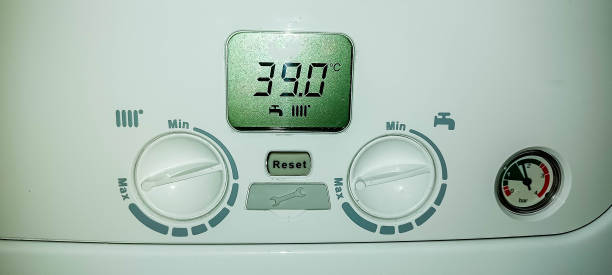
Vaillant F75 Fault Code – Causes, Pressure Sensor, Pump & Repair Guide
The Vaillant F75 fault code means the boiler has detected too little pressure change when the heating pump starts. On relevant Vaillant ecoTEC boilers, the control system expects to see a pressure change as the pump begins circulating heating water. If that change is insufficient or isn't detected correctly, the boiler can lock out and display F75.
Vaillant lists several possible causes, including low system pressure, air in the heating system, a defective water-pressure sensor, a faulty heating pump and wiring problems. Model-specific technical documentation also identifies circulation, bypass and expansion-vessel issues as areas an engineer may need to investigate.
Through FraserBond.com, homeowners, landlords and property managers can explore Vaillant boiler repairs, central-heating services and property maintenance.
What Does F75 Mean on a Vaillant Boiler?
Vaillant currently defines F75 as:
The pressure change is too low when the heating pump starts.
The operating sequence is essentially:
Heating demand → Pump starts → Pressure should change → Boiler fails to detect sufficient change → F75 lockout
The fault therefore relates primarily to the relationship between water pressure, the pump and pressure detection rather than simply indicating that the boiler has run out of water.
What Causes a Vaillant F75 Fault?
The main causes identified by Vaillant include:
- System pressure below the normal range
- Air in the boiler or heating system
- Faulty water-pressure sensor
- Defective internal heating pump
- Open circuit or wiring-harness fault
- Insufficient water in the system
- Circulation restriction
- Expansion-vessel problem on applicable models
Vaillant's ecoTEC technical documentation also tells engineers to check the heating circuit, adjustable bypass and expansion-vessel arrangement when diagnosing certain F75 faults.
This is why replacing the pump immediately isn't always the correct solution.
Check Your Vaillant Boiler Pressure
The first homeowner-level check is the system pressure.
Vaillant states that normal pressure is generally around 1–1.5 bar. If an F75 boiler is showing less than 1 bar, Vaillant says a competent user may follow the appropriate model instructions to repressurise it to approximately 1–1.5 bar.
For example:
0.4 bar → Too low
0.7 bar → Too low
1.2 bar → Within Vaillant's stated normal range
1.5 bar → Within Vaillant's stated normal range
Always check the instructions for your particular boiler because filling arrangements vary.
Vaillant F75 With Pressure Below 1 Bar
If F75 appears and pressure is below 1 bar, insufficient water pressure could be contributing to the fault.
Vaillant's guidance is to locate the appropriate filling arrangement and slowly restore pressure to around 1–1.5 bar, provided you're competent to do so and follow the instructions for the particular boiler.
Don't continue filling indefinitely.
Once the correct pressure has been reached, close the filling arrangement properly.
Vaillant F75 but Pressure Is Normal
This is an important distinction.
If your boiler displays:
F75 + 1.2 bar
or:
F75 + 1.5 bar
adding more water isn't necessarily the answer.
Vaillant says that where F75 occurs and system pressure is above 1 bar, professional attention is appropriate rather than opening the boiler yourself.
At normal static pressure, the engineer may need to investigate the pressure sensor, pump, circulation, air, expansion vessel or electrical connections.
Vaillant F75 Pressure Sensor Fault
The water-pressure sensor is one of the principal components associated with F75.
Its job includes providing the boiler with pressure information.
When the pump starts, the boiler expects the sensor readings to reflect an appropriate pressure change. If the sensor is defective, the boiler may fail to recognise that change correctly.
Vaillant's current ecoTEC plus technical instructions specifically identify a defective water-pressure sensor as a possible F75 cause.
How Is an F75 Pressure Sensor Diagnosed?
This is an engineer-level diagnostic task.
Vaillant's professional fault-finding guidance describes checking the pressure sensor and, on relevant models, draining the boiler to establish whether the sensor correctly reads zero. It advises replacement where the reading demonstrates the sensor is defective.
This is considerably better than replacing the sensor simply because F75 appears.
The fault code identifies an operating condition; it doesn't prove which component caused it.
Vaillant F75 Pump Fault
The internal heating pump is another recognised F75 cause.
Vaillant's technical instructions direct engineers to check the heating pump and, depending on the model, investigate whether it is blocked or defective.
A pump-related F75 could involve:
- Pump not starting
- Pump blocked
- Pump mechanically defective
- Electrical supply problem
- Wiring problem
- Restricted circulation
Professional testing should establish whether the pump actually needs replacing.
Does F75 Mean the Pump Has Failed?
No.
This is one of the most important points about the Vaillant F75 fault code.
Although pump failure is a recognised cause, F75 can also result from:
- Low pressure
- Insufficient water
- Air
- Pressure-sensor fault
- Wiring fault
- Circulation problem
- Expansion-vessel issue
Vaillant's own fault tables identify several possibilities rather than diagnosing F75 exclusively as pump failure.
Don't approve an expensive pump replacement solely because the display says F75.
F75 Caused by Air in the Heating System
Air in the boiler or heating circuit is another official Vaillant-listed cause.
Air can become relevant after:
- Radiator replacement
- Radiator bleeding
- Heating-system draining
- Boiler repairs
- Pipework alterations
- Pressure loss
- Refilling the system
If F75 first appeared immediately after heating work, tell the engineer.
That timing may provide an important diagnostic clue.
Vaillant F75 After Bleeding Radiators
Bleeding radiators releases trapped air but can also reduce the pressure in a sealed heating system.
Therefore:
Bleed radiators → Pressure falls → Boiler starts → F75 appears
can sometimes be resolved by correctly restoring system pressure.
Check the pressure gauge or digital reading.
If it is below the normal range, follow the manufacturer's model-specific repressurisation instructions.
Vaillant F75 After Repressurising
Suppose the sequence is:
F75 → Pressure 0.6 bar → Repressurise to 1.3 bar → Reset → F75 remains
At that point, low static pressure is unlikely to be the complete explanation.
Professional diagnosis may need to progress through:
Pressure Sensor → Pump → Air/Circulation → Expansion Vessel → Wiring
Vaillant's technical information supports this broader approach.
Vaillant F75 Expansion Vessel Problem
The expansion vessel helps accommodate changes in heating-water volume as the system heats and cools.
On current ecoTEC plus technical documentation, Vaillant lists a defective internal expansion vessel among possible F75 causes.
Vaillant's professional fault-finding guidance also tells engineers investigating relevant F75 faults to check expansion-vessel charge as part of diagnosis.
This isn't a homeowner repair.
Signs of an Expansion Vessel Problem
Possible warning behaviour can include:
- Pressure rises substantially as heating warms up
- Pressure falls significantly when system cools
- Frequent need to repressurise
- Water discharging through safety pipework
These symptoms don't prove that the expansion vessel is defective.
They simply provide useful information for the engineer.
Vaillant F75 Keeps Coming Back
An intermittent F75 deserves investigation even if resetting temporarily restores the boiler.
For example:
F75 → Reset → Boiler works for two days → F75 returns
suggests the underlying condition hasn't been permanently resolved.
Record:
- Pressure when cold
- Pressure when hot
- When F75 appears
- Whether reset works
- Whether pressure falls
- Whether radiators were recently bled
- Whether unusual pump noises occur
This information can make intermittent faults easier to diagnose.
Vaillant F75 After a Power Cut
If F75 first appears after an interruption to the electricity supply, following the normal reset procedure may restore operation if the fault is temporary.
Vaillant notes that resetting can sometimes clear or temporarily resolve boiler fault conditions, and recommends following the user manual for the specific model.
However:
Reset → F75 returns repeatedly
means further investigation is appropriate.
Can You Reset a Vaillant F75?
Yes, a normal user reset may be attempted according to the instructions for the particular boiler.
However, resetting doesn't repair:
- Failed pump
- Faulty pressure sensor
There is probably a Fraser Bond team for it.
Lettings & management
Finding tenants, running tenancies, and holding the compliance paperwork so you never have to look for it.
Investment & portfolio
Buying well, holding sensibly, and knowing when a property has stopped earning its place.
Commercial property
Offices, retail and mixed use — acquisition, lettings, lease advice and building management.
Professional services
Valuation, lease consultancy, building consultancy and expert advice when a decision needs evidence behind it.
You are one message away from an answer.
Send it to us and get a straight answer.
Describe the property and the problem. We will tell you what we would do, what it should cost, and if we are not the right people, who is.
- Replies the same working day
- The person who answers is the person who handles it
- No fee, and no obligation to instruct us
See everything we are instructed on.
Sales and lettings across Prime Central London and the wider UK, with the same team behind every listing.
- Residential and commercial in one search
- Filter by borough, budget and size
- Register once and we will send matches first
Other insights you may find useful.
 Senior Housing & Assisted Living
Later Living - A Guide to Retirement and Senior Living Property in the UK
Read → Property Maintenance & Repairs
Window Repair UK - Window Glass, Frames and Property Maintenance Guide
Read → Property & Real Estate Services
London High Level Cleaning Services - Industrial Cleaning Experts
Read → Property & Real Estate Services
Properties to Rent in 363-365 Clapham Road - London SW9
Read → Supported Living & Specialist Housing
Specialist Dementia Accommodation - UK Property
Read →
Property & Real Estate Services