Toilet Unblocker – How to Unblock a Toilet Safely
A toilet unblocker can help clear common toilet blockages caused by excess toilet paper, waste or minor obstructions in the trap or waste pipe. For simple problems, a toilet plunger may be enough. Repeated blockages, sewage backing up or problems affecting several drains can indicate a deeper drainage issue requiring a professional drainage contractor.
For landlords and property managers, blocked toilets should also be treated as a maintenance issue rather than repeatedly clearing the symptom. In England, landlords are generally responsible for sanitary fittings, pipes and drains, although a tenant may be responsible for damage or a blockage they caused. GOV.UK
Through FraserBond.com, landlords, freeholders, RMCs, RTMs and property owners can coordinate drainage investigations, toilet repairs and specialist maintenance contractors.
What Causes a Blocked Toilet?
Common causes include:
- Excess toilet paper
- Wet wipes
- Sanitary products
- Nappies
- Cotton products
- Foreign objects
- Scale and deposits
- Blocked waste pipes
- Drainage defects
- Tree roots further along the drainage system
- Damaged or displaced underground pipes
Only toilet paper and human waste should normally be flushed. Wet wipes and sanitary products can contribute to blockages because they do not break down like toilet paper. Central Bedfordshire Council
Signs Your Toilet Is Blocked
A blockage is not always a toilet that refuses to flush completely.
Warning signs include:
Slow Flush → Rising Water → Gurgling → Poor Drainage → Overflow
You might also notice water rising unusually high before slowly draining away.
If sinks, baths or other toilets are also draining badly, the problem may be farther down the drainage system rather than inside the toilet itself.
How to Unblock a Toilet
For a straightforward blockage, start with the least aggressive method.
1. Stop Flushing
Do not repeatedly flush a blocked toilet.
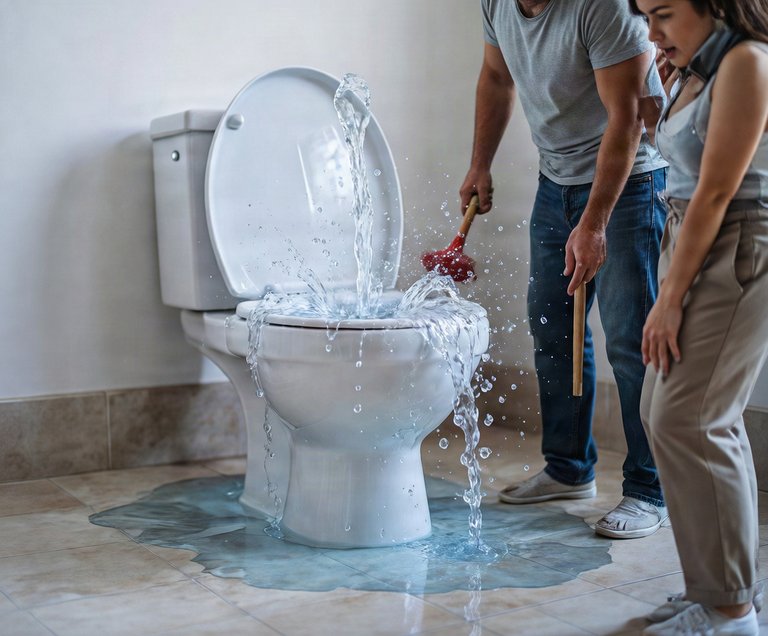
If the water is already high, another flush could cause contaminated water to overflow onto the floor.
2. Use a Toilet Plunger
A proper toilet plunger creates pressure around the outlet.
Position it securely over the opening and use controlled pumping movements to try to move the obstruction.
After the blockage appears to clear, test the toilet carefully rather than immediately flushing repeatedly.
3. Check the Water Level
If the bowl begins draining normally again, allow it to settle before testing the flush.
If the water continues rising or draining extremely slowly, stop using the toilet until the problem is resolved.
Toilet Plunger vs Chemical Toilet Unblocker
A plunger is often a sensible first option because it attempts to clear the obstruction mechanically.
Chemical drain products require greater caution. They may not be appropriate for every blockage, pipe system or toilet, and mixing different drain-cleaning chemicals can be hazardous.
If using any proprietary product, follow its manufacturer instructions and warnings exactly. Never mix different cleaning or drain-unblocking chemicals.
For persistent toilet blockages, professional mechanical clearance is generally more useful than repeatedly adding chemicals without identifying the underlying problem.
When a Toilet Unblocker Does Not Work
If plunging fails, the blockage may be:
- Deeper inside the waste pipe
- Within a soil stack
- Underground
- Caused by a foreign object
- Connected with damaged drainage
- Affecting communal pipework
At this point, repeatedly flushing the toilet can make matters worse.
A drainage specialist may use professional equipment to locate and clear the obstruction.
Toilet Auger and Professional Drain Equipment
Specialist contractors have access to equipment beyond an ordinary household plunger.
Depending on the blockage, this can include:
- Toilet augers
- Drain rods
- Mechanical cleaning equipment
- High-pressure water jetting
- CCTV drain cameras
The correct equipment depends on where the obstruction is located.
Care is important because inappropriate tools can damage the toilet or pipework.
Repeatedly Blocked Toilet
A toilet that blocks repeatedly deserves further investigation.
Consider the pattern:
Toilet Blocks → Blockage Cleared → Toilet Works → Blockage Returns
This can indicate that the obstruction was only partially removed or that another drainage defect is causing the problem.
Potential causes include:
- Pipe damage
- Poor drainage falls
- Scale
- Root intrusion
- Displaced joints
- Partial collapse
- Recurring accumulation
A CCTV drain survey may be appropriate when the cause cannot be established through normal drainage investigation.
CCTV Drain Survey for Toilet Blockages
A CCTV survey allows a drainage contractor to inspect accessible underground pipework internally.
The process can be:
Clear Blockage → Insert Camera → Identify Defect → Locate Problem → Recommend Repair
This can be particularly useful when a toilet or drain continues blocking after previous clearance.
Camera surveys may identify cracked pipes, displaced joints, roots, obstructions and other defects.
Blocked Toilet and Blocked Drain
It is important to distinguish between the two.
| Problem | Possible Location |
|---|---|
| One toilet blocked | Toilet/trap/local waste pipe |
| Several toilets blocked | Stack or drainage system |
| Toilet and sink affected | Shared drainage |
| Outside gully overflowing | Underground drainage |
| Neighbours affected | Potential shared/public sewer issue |
The more fixtures affected, the more likely it is that the problem lies beyond the individual toilet.
Sewage Coming Up Through the Toilet
Sewage backing up into a toilet requires more urgent attention.
Stop using affected toilets, sinks, showers and other connected fixtures where continued discharge could worsen the backup.
Avoid direct contact with sewage and keep children and pets away from contaminated areas.
Professional drainage assistance may be required to establish whether the problem is within the private drain, shared drainage or public sewer.
Who Is Responsible for a Blocked Drain?
In England, responsibility depends on where the blockage occurs.
Ofwat states that drains and private sewers carrying household waste are normally the householder's or landlord's responsibility until they connect with the public sewer, which is usually around the property boundary. Many private sewers outside property boundaries transferred to sewerage companies in 2011. Ofwat
If several properties are affected, the sewerage company may therefore need to investigate.
Blocked Toilet in a Rented Property
Responsibility between landlord and tenant depends partly on the cause.
Government guidance states that landlords are responsible for repairs to sanitary fittings including basins, sinks and baths, as well as associated pipes and drains. Tenants can be responsible for damage they, their household or visitors cause. GOV.UK
This distinction matters with blockages.
For example, a defect in the drainage system may be a landlord repair issue, whereas a blockage caused by inappropriate items flushed by the tenant may result in the tenant being responsible for the clearance cost. Local-authority guidance similarly distinguishes between drainage defects and blockages caused by unsuitable items. Central Bedfordshire Council
How Quickly Should a Landlord Fix a Blocked Toilet?
The urgency depends on the circumstances, including whether another working toilet is available.
For example, Manchester City Council's private-landlord guidance says a toilet should be unblocked within 24 hours, contrasting this with less urgent repairs such as a dripping tap. Manchester City Council
Landlords should respond particularly quickly where the property has no usable toilet or sewage is overflowing.
Blocked Toilet in an Apartment
In an apartment building, the problem may not belong solely to the individual flat.
The drainage route can be:
Toilet → Branch Pipe → Soil Stack → Underground Drain → Sewer
A blockage within the apartment's local pipework may be associated with that property.
A blockage in a communal stack or shared underground drainage may instead require involvement from the freeholder, RMC, RTM or block managing agent.
The lease and location of the defect can help determine responsibility.
Blocked Toilet in an HMO
A blocked toilet in a House in Multiple Occupation can affect several residents.
Government guidance states that landlords of certain shared properties have additional obligations concerning communal areas and shared facilities, including bathrooms and toilets. GOV.UK
Where several occupants depend on the same sanitary facilities, rapid investigation can be particularly important.
Toilet Blockage in Commercial Property
Blocked toilets can also disrupt:
- Offices
- Restaurants
- Retail premises
- Hotels
- Warehouses
- Schools
- Mixed-use developments
Commercial buildings may have multiple toilets connected to shared soil stacks and underground drainage.
If several facilities fail simultaneously, a drainage contractor should investigate the wider system rather than simply attempting to unblock each toilet independently.
Preventing Blocked Toilets
Prevention is usually simpler than emergency clearance.
Avoid flushing:
- Wet wipes
- Sanitary products
- Nappies
- Cotton pads
- Paper towels
- Food
- Grease
- Foreign objects
Only human waste and toilet paper should normally go down the toilet. Central Bedfordshire Council
In frequently occupied rental or commercial properties, clear resident or staff guidance can help reduce avoidable blockages.
When to Call a Professional Toilet Unblocker
Professional assistance is advisable when:
- Plunging does not work
- The toilet repeatedly blocks
- Several toilets are affected
- Other drains are backing up
- Sewage is overflowing
- An outside drain is overflowing
- A foreign object is suspected
- Drainage damage is suspected
Recurring problems may justify a CCTV survey after the immediate blockage has been dealt with.
Emergency Blocked Toilet
Treat the situation more urgently where:
The Only Toilet Is Unusable + Sewage Is Overflowing + Multiple Drains Are Backing Up
Do not continue flushing or using connected fixtures if this causes sewage to rise.
If wastewater is approaching electrical equipment, sockets or wiring, avoid contact with the affected electrical installation and obtain appropriate professional assistance.
How Fraser Bond Can Help
Through FraserBond.com, landlords, freeholders, RMCs, RTMs, investors and property owners can access property-maintenance support covering:
- Blocked toilets
- Blocked drains
- Drainage contractors
- CCTV drain surveys
- Plumbing maintenance
- Emergency maintenance
- Contractor coordination
- Residential property management
- Block management
- Commercial property management
- Planned and reactive maintenance
Where specialist plumbing or drainage work is required, appropriately competent contractors should be used.
Professional Toilet Unblocking and Drainage Support
A toilet unblocker such as a suitable plunger can resolve many straightforward household blockages. If the problem keeps returning, affects several fixtures or causes sewage to back up, further drainage investigation is usually more appropriate than repeatedly treating the toilet itself.
For landlords, the underlying cause is also important when determining responsibility: sanitary fittings, pipes and drains generally fall within landlord repair obligations in England, while tenants may be responsible for damage or blockages they have caused. GOV.UK
Visit FraserBond.com to discuss blocked toilets, drainage maintenance, CCTV drain surveys and property-maintenance support.