


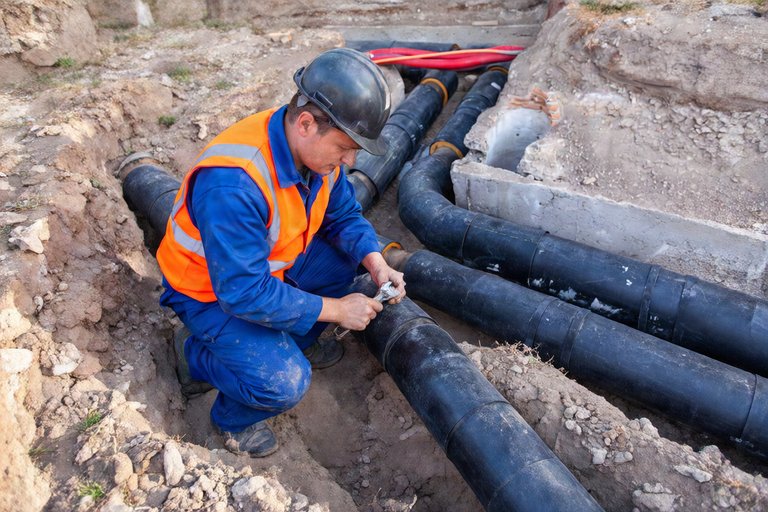
A damaged or leaking water line can cause low water pressure, unexpectedly high water consumption, damp ground and, in more serious cases, flooding or damage to a property. In the UK, the term water supply pipe is more commonly used for the underground pipe carrying clean water from the water company's infrastructure into a home or commercial building.
Water line repair can involve locating an underground leak, repairing a damaged section of supply pipe or replacing an ageing pipe completely. Establishing exactly where the leak is located is particularly important because responsibility for water pipes is divided between the property owner and the local water company.
For homeowners, landlords and investors, dealing with a suspected supply-pipe leak promptly can help prevent unnecessary water loss and potentially more extensive property damage.
What Is a Water Line?
A property's water line or water supply pipe carries clean mains water into the building.
Ofwat distinguishes between three main parts of the water-supply network: the water main, the communication pipe and the private supply pipe. Water companies maintain the water mains and communication pipes, while property owners are usually responsible for the supply pipe serving their property.
The exact arrangement can differ for shared supplies and unusual property configurations, so responsibility should be confirmed before commissioning major repair work.
Signs You May Need Water Line Repair
Underground supply pipes can leak without producing an obvious burst of water.
Some leaks develop gradually and may remain unnoticed until they begin affecting water pressure or surrounding ground.
Possible warning signs include:
- Unexplained increases in metered water consumption
- Reduced water pressure inside the property
- Wet or unusually soft ground during dry weather
- Water collecting around a driveway or garden
- The sound of running water when fixtures are turned off
- Damp appearing around the building
- A water meter continuing to record usage when no water is intentionally being used
- Repeated supply-pipe leaks
These symptoms do not prove that the supply pipe is leaking, but they can justify further investigation.
What Causes a Water Line to Leak?
Underground pipes operate in demanding conditions and can deteriorate or become damaged over time.
Ofwat notes that water pipes can develop leaks because of deterioration, freezing weather and external loads such as traffic.
Ground movement can also place stress on underground services.
Older supply pipes may eventually become less reliable, particularly where the material has deteriorated or previous repairs have already been necessary.
Accidental damage is another possibility. Excavation, landscaping and construction work can damage underground pipes if their position is not identified beforehand.
Who Is Responsible for Water Line Repair?
Responsibility depends on which pipe is leaking.
In England and Wales, the water company generally maintains the water main and communication pipe. The property owner is usually responsible for the private supply pipe from the property boundary into the building.
This means a leak beneath a homeowner's driveway or garden may be the owner's responsibility even though the pipe carries mains water.
However, Ofwat advises that there can be exceptions. Shared supply pipes, property deeds and local arrangements can affect responsibility.
Contacting the local water company before commissioning substantial work can therefore be worthwhile.
Shared Water Supply Pipes
Some properties share a supply pipe with neighbouring buildings.
This arrangement can occur in older terraces, converted properties and some other residential developments.
Ofwat states that a shared supply pipe serving more than one property can be the joint responsibility of the property owners it serves.
A shared supply can make repair decisions more complicated because several properties may need to be considered.
It can also influence water pressure where demand from multiple households passes through the same pipe.
Where responsibility is uncertain, owners should establish the physical layout and relevant ownership arrangements before authorising extensive work.
How Is an Underground Water Leak Found?
Finding the exact position of a leak can be one of the most important stages of water line repair.
Excavating large areas of a garden or driveway simply to search for a leaking pipe can be disruptive and expensive.
Specialist leak-detection techniques can help narrow down the location before excavation begins.
The appropriate method depends on the pipe material, site conditions, accessibility and characteristics of the leak.
Once the suspected location has been established, a contractor can expose the relevant section and determine whether repair or replacement is appropriate.
Repairing a Leaking Water Supply Pipe
A localised defect does not always require replacement of the entire supply line.
If the rest of the pipe remains in satisfactory condition, the damaged section may potentially be repaired.
The contractor will normally isolate the water, expose the affected pipe and assess the defect before completing the appropriate repair.
The repaired system should then be checked before excavation is reinstated.
The condition of the surrounding pipe matters. A single repair on an otherwise reliable supply pipe is different from repeatedly repairing an ageing line that continues to develop leaks.
Water Line Repair or Complete Replacement?
Repeated leaks can indicate that the existing supply pipe is reaching the end of its practical service life.
In that situation, continually repairing individual sections may become less economical than replacing the pipe.
Complete replacement can also be considered when an older supply is being upgraded for other reasons, such as poor pressure, redevelopment or replacement of outdated materials.
WaterSafe advises that approved Water Supply Pipe Installers can undertake installation, repair and replacement of underground supply pipes between the external and internal stop taps.
A professional assessment should determine whether local repair or complete renewal represents the more appropriate solution.
Trenchless Water Line Replacement
Traditional supply-pipe replacement can involve excavating a trench along the pipe route.
Depending on the property and site conditions, alternative installation techniques may reduce the amount of excavation required.
Specialist contractors can sometimes install replacement supply pipes using methods that require only limited access points.
This can be particularly attractive where a water line runs beneath driveways, landscaping or other finished areas.
Not every property is suitable for the same installation method, however. Existing utilities, pipe routes, ground conditions and access all influence the available options.
Low Water Pressure and Water Lines
Poor pressure does not automatically mean that the supply pipe needs replacing.
A partially closed stop tap, internal plumbing restriction or wider network issue can produce similar symptoms.
However, a leaking or inadequate private supply pipe can contribute to poor performance.
Older shared supplies can also struggle where several households draw water simultaneously.
Before installing pumps or carrying out major plumbing alterations, the incoming supply should be assessed to establish whether the underlying problem originates in the water line.
Burst Water Line
A substantial supply-pipe failure can release large quantities of water into the surrounding ground.
Where the leak is on private pipework, the water supply may need to be isolated while emergency repair is arranged.
Visible water emerging from a road or public area should instead be reported to the relevant water company where it appears to involve its network.
Ofwat advises that water companies are responsible for maintaining and repairing their mains and communication pipes.
Establishing whether the problem is on private or company-owned infrastructure can therefore prevent unnecessary delays.
Can the Water Company Repair a Private Water Line?
Possibly.
Ofwat recommends contacting the relevant water company because some companies provide free or subsidised assistance with private supply-pipe leaks. Policies differ between suppliers.
Some schemes may be limited to particular types of leaks, locations or properties.
Property owners should therefore check their water company's current policy before assuming that they must privately fund all work.
Home insurance or specialist plumbing cover may also provide assistance depending on the policy terms.
High Water Bills and Supply-Pipe Leaks
A hidden leak can increase metered water consumption substantially.
If a water meter continues registering usage when all taps, appliances and other known water outlets are off, further investigation may be warranted.
Ofwat states that customers whose metered bills increased because of a leak that has subsequently been repaired may be able to claim an allowance for water lost, depending on their water company's policy.
Customers should contact their supplier directly to determine whether they qualify and what evidence is required.
Lead Water Supply Pipes
Older UK properties can still contain lead supply pipes.
A leaking lead supply pipe may provide an opportunity to consider complete replacement rather than simply repairing the damaged section.
WaterSafe advises homeowners and businesses that they are generally responsible for lead pipes within their property, including the underground supply pipe, and recommends approved materials such as suitable copper or plastic when lead pipework is replaced.
Property owners considering lead-pipe replacement should also contact their water company because assistance or coordinated replacement of company-owned sections may be available.
Water Line Repair for Landlords
A private water-supply leak can become a significant maintenance issue in a rental property.
Landlords should investigate reports of low pressure, unexplained damp or visible external leakage rather than waiting for the supply to fail completely.
Keeping records of previous leaks can also be useful.
If the same supply pipe has required several repairs, its overall condition should be considered rather than continually treating individual defects.
Fraser Bond supports landlords through lettings, compliance guidance and property advisory services, helping property owners approach maintenance as part of wider asset management.
Water Line Repairs for Commercial Properties
Commercial buildings can have considerably greater water demand than individual homes.
Hotels, restaurants, offices, retail premises and multi-unit residential developments may depend on larger or more complicated water-supply infrastructure.
A significant leak can therefore create operational disruption in addition to water loss.
Commercial property managers should understand the route of private supply pipes, the location of isolation valves and which sections are their responsibility.
Planned replacement can sometimes be preferable to waiting for an ageing supply line to fail unexpectedly.
Water Line Repair During Property Renovation
Major refurbishment provides an opportunity to assess ageing water infrastructure.
If driveways, gardens or floors are already being excavated, replacing an unreliable supply pipe during the project may be less disruptive than returning later.
Developers adding bathrooms or substantially changing a property's use should also consider whether the existing incoming supply is appropriate for future demand.
A larger property does not automatically require a replacement supply, but pressure, flow and pipe condition should be considered as part of the wider plumbing design.
Water Lines When Buying a Property
Underground water supplies are easy to overlook during property due diligence.
Buyers considering older houses may want to establish whether the property has a shared supply, outdated pipe material or a history of previous leaks.
Evidence of unusually wet ground, poor pressure or repeated supply
There is probably a Fraser Bond team for it.
Lettings & management
Finding tenants, running tenancies, and holding the compliance paperwork so you never have to look for it.
Investment & portfolio
Buying well, holding sensibly, and knowing when a property has stopped earning its place.
Commercial property
Offices, retail and mixed use — acquisition, lettings, lease advice and building management.
Professional services
Valuation, lease consultancy, building consultancy and expert advice when a decision needs evidence behind it.
You are one message away from an answer.
Send it to us and get a straight answer.
Describe the property and the problem. We will tell you what we would do, what it should cost, and if we are not the right people, who is.
- Replies the same working day
- The person who answers is the person who handles it
- No fee, and no obligation to instruct us
See everything we are instructed on.
Sales and lettings across Prime Central London and the wider UK, with the same team behind every listing.
- Residential and commercial in one search
- Filter by borough, budget and size
- Register once and we will send matches first
Other insights you may find useful.
 Property Management & Rentals/ Lettings
Property Management Surrey - Professional Property Management Services for Landlords, Home...
Read → Property & Real Estate Services
London Investors - Expert Asset Recovery Lawyer UK
Read → Property & Real Estate Services
Professional Guest Services Staff for London Properties - Fraser Bond
Read → Property & Real Estate Services
Properties to Rent in The Courthouse - London SW1P
Read → Property & Real Estate Services
Properties to Rent in One Hundred Shoreditch - London E1
Read → Property & Real Estate Services