Drone Survey London - Professional Drone Roof Surveys and Aerial Property Inspections
Drone surveys in London provide homeowners, landlords, freeholders, property managers, developers and investors with a practical way to inspect roofs, chimneys, façades and other difficult-to-access parts of buildings. Using high-resolution aerial photography and specialist surveying equipment, drone inspections can help identify visible defects, assess maintenance requirements and support property investment decisions.
Across London, where properties range from Victorian terraces and Georgian townhouses to modern apartment blocks and commercial developments, traditional high-level inspections can be complicated by building height, restricted access and the cost of scaffolding.
A professional drone roof survey in London can provide detailed visual information before more intrusive investigations or repair work is commissioned.
Fraser Bond supports London property owners with property management, sales, lettings, investment advisory and wider real estate services through FraserBond.com.
Professional Drone Survey Services in London
A drone survey uses an unmanned aircraft equipped with a camera or specialist sensor to capture images and data from elevated positions.
For property inspections, drones are particularly useful where roof coverings, chimney stacks and upper building elevations cannot be viewed adequately from ground level.
Professional drone survey services can support:
-
Roof inspections and leak investigations.
-
Chimney stack and lead flashing assessments.
-
Gutter, parapet and drainage inspections.
-
External façade and masonry condition surveys.
-
Commercial roof and apartment-block inspections.
-
Pre-purchase property investigations.
-
Planned maintenance and refurbishment assessments.
The resulting imagery can help surveyors and contractors identify visible defects and determine whether further investigation is necessary.
Drone Roof Survey London
Roof inspections are among the most common applications of drone surveying.
A drone can capture high-resolution images of pitched and flat roofs without requiring an inspector to walk across the roof surface.
This can be particularly useful for tall buildings, steeply pitched roofs and properties with limited access.
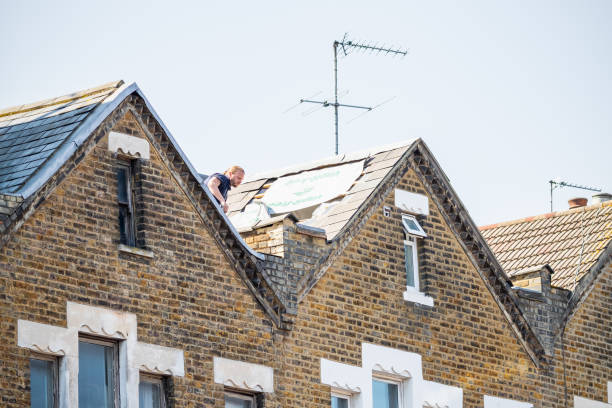
A drone roof survey may reveal slipped slates, cracked tiles, damaged ridge details, defective flashing and visible deterioration around roof penetrations.
The Royal Institution of Chartered Surveyors recognises that drones can assist with high-level data collection, particularly for roofs, chimney stacks, gutters and flashing.
However, aerial imagery should be interpreted by someone with suitable building knowledge.
Drone Surveys for Flat Roofs
Flat roofs are common on London residential extensions, apartment buildings, offices and commercial properties.
Aerial inspections can help identify visible membrane damage, standing water, blocked drainage outlets and deterioration around rooflights or parapets.
For larger flat roofs, drone imagery can provide an overview of areas that would otherwise require extensive physical access.
However, photographs cannot reliably establish the condition of concealed insulation, structural decking or waterproofing layers.
Where moisture penetration is suspected, further specialist investigation may be required.
Drone Chimney Surveys London
London's traditional housing stock contains numerous chimney stacks exposed to prolonged weathering.
Drone inspections can provide close visual records of chimney brickwork, mortar joints, pots, flaunching and surrounding roof details.
This can help identify cracked masonry, deteriorated pointing, loose chimney components and visible flashing defects.
A drone survey can be particularly useful where a chimney is difficult to inspect safely from ground level.
Where structural instability is suspected, a competent professional should determine whether additional inspection or immediate safety measures are necessary.
Drone Building Surveys London
Drone technology can also support wider building-condition assessments.
High-level imagery can reveal visible defects in external walls, parapets, roof edges and architectural features.
For period properties, this may include deterioration around decorative masonry, cornices and chimney stacks.
Drone surveys can help building surveyors understand the extent of visible deterioration before specifying further investigations.
RICS cautions that technology should supplement professional building assessment rather than replace the investigation needed to establish the causes of defects.
Drone Façade Surveys
Building façades can be difficult to inspect where upper floors are inaccessible from windows or adjacent structures.
A drone façade survey can capture detailed imagery of external walls and architectural features.
Potential defects include cracked render, deteriorated pointing, displaced materials and visible water staining.
These observations can help inform maintenance planning.
However, aerial photography cannot establish the condition of concealed fixings or confirm whether apparently sound façade materials are securely attached.
Where safety-critical defects are suspected, hands-on inspection and specialist assessment may still be necessary.
Drone Surveys for London Landlords
Landlords may use drone surveys to investigate roof problems or assess maintenance requirements.
For traditional rental houses, aerial inspections can help identify damaged tiles, defective gutters and deterioration around chimneys.
Where a leak has been reported, drone imagery may assist in narrowing down the area requiring closer investigation.
Professional property management can help coordinate the survey, review its findings and arrange appropriate follow-up inspections or repairs.
For overseas landlords, aerial inspection reports can provide useful visual documentation of a property's external condition.
Drone Surveys for Apartment Blocks
Apartment buildings frequently contain communal roofs, parapets, gutters and external elevations that are difficult to inspect.
Drone surveys can assist freeholders, Residents Management Companies, Right to Manage companies and managing agents with condition assessments.
Aerial imagery can support the preparation of maintenance schedules and contractor specifications.
Where significant repairs are anticipated, a drone survey may help establish which areas require detailed investigation.
It should not, however, be treated as a substitute for any statutory building-safety assessment or specialist façade inspection.
Commercial Drone Surveys London
Commercial properties can benefit from aerial inspections where roofs cover large areas or contain complex building services.
Warehouses, offices, retail premises and mixed-use developments may have extensive flat roofing systems, rooftop plant and numerous drainage outlets.
Drone surveys can help identify visible defects and document the overall roof condition.
For occupied commercial buildings, a planned aerial inspection may also reduce the need for some preliminary access arrangements.
The survey should be scheduled with appropriate attention to site safety, neighbouring occupiers and airspace restrictions.
Drone Surveys for Property Developers
Developers can use drone surveys during acquisition, refurbishment and construction planning.
Aerial imagery can help establish the visible condition of existing roofs, façades and difficult-to-access architectural features.
This information may be useful when preparing feasibility assessments and preliminary refurbishment budgets.
Drone photography can also document construction progress and record the external condition of buildings at different project stages.
Where measurements, mapping or three-dimensional models are required, the scope should specify the accuracy and technical deliverables needed.
Pre-Purchase Drone Surveys London
A drone survey can be a useful supplementary investigation before purchasing a property.
Traditional London houses may contain roofing defects that are difficult to assess from ground level.
Aerial photographs can help identify visible damage to slates, tiles, chimney stacks and roof junctions.
For property investors, identifying potential roofing expenditure before purchase can improve budgeting.
However, a drone survey does not replace an appropriately scoped building survey.
RICS explains that home surveys involve professional assessment of building condition and, depending on the survey level, advice concerning defects and maintenance.
Drone Surveys for Period Properties
London's Georgian, Victorian and Edwardian buildings often feature intricate roof forms and historic architectural details.
These can include slate roofs, clay tiles, lead valleys, parapets and decorative chimney stacks.
A drone survey can document their visible condition without requiring immediate physical access.
For listed buildings and properties within conservation areas, aerial imagery may also help record existing architectural features before repairs are planned.
Specialist interpretation remains important where traditional materials and historic construction methods are involved.
Drone Surveys Across London
Drone surveying can support property inspections across Central, North, South, East and West London, subject to site and flight restrictions.
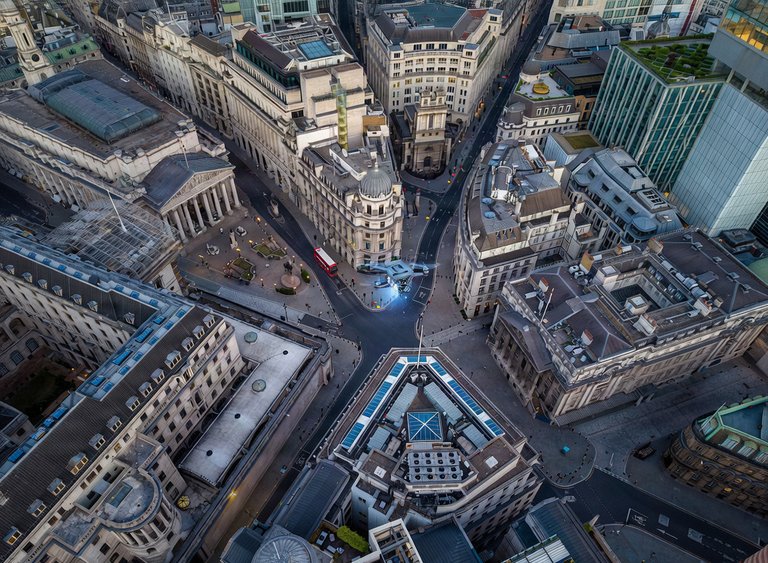
In Central London, high-rise buildings, dense development and restricted access can make aerial inspection useful, although airspace and operational constraints may be significant.
In West London, including Chelsea, Fulham, Hammersmith and Kensington, drone surveys can assist with traditional townhouses, residential extensions and converted properties.
In North London, areas such as Hampstead, Highgate and Islington contain historic properties where roof and chimney inspections may benefit from aerial photography.
Across East London, including Stratford, Hackney, Canary Wharf and Bow, drone surveys can support both traditional residential buildings and modern developments.
In South London, including Clapham, Greenwich, Dulwich and Wimbledon, aerial inspections can help assess residential roofs, chimneys and apartment buildings.
The feasibility of flying must be assessed for each property rather than assumed from its postcode.
Drone Survey Regulations in London
Drone surveying in London must comply with UK Civil Aviation Authority requirements.
The rules depend on the drone's weight and class, the type of operation, proximity to people and applicable airspace restrictions.
Under current CAA rules, drones weighing 100g or more generally require a Flyer ID, while drones weighing 100g or more with a camera also require an Operator ID.
The CAA distinguishes between lower-risk Open Category flights and more complex Specific Category operations.
Operations outside the Open Category require an appropriate CAA operational authorisation. The CAA specifically identifies roof inspections and building photography as activities that may be undertaken under its PDRA01 authorisation, subject to the relevant conditions.
A professional drone operator should establish the legal and operational requirements before conducting the survey.
London Airspace Restrictions
London contains controlled and restricted airspace, including areas associated with airports, government buildings and other sensitive locations.
A drone operator must check the airspace restrictions applicable to the proposed flight.
Permission or operational authorisation may be required depending on the location and flight plan.
Property owners should not assume that a drone can legally fly over every London building.
Drone Surveys and Privacy
Aerial inspections may capture neighbouring properties, windows, gardens or other private areas.
Professional operators should plan flights to minimise unnecessary recording and respect privacy.
Where imagery contains identifiable individuals or other personal information, applicable data-protection requirements may need to be considered.
For apartment blocks and occupied properties, managing agents should communicate relevant access and survey arrangements where appropriate.
Drone Survey Reports
The value of a drone survey depends on the quality of both the imagery and its interpretation.
A professional report may include high-resolution photographs, annotated images, descriptions of visible defects and recommendations for further investigation.
The report should distinguish between observed conditions and suspected causes.
For example, a photograph may show damaged flashing, but it may not establish whether the flashing is responsible for an internal leak.
Clear reporting helps owners decide whether to commission repairs, further surveys or specialist testing.
Can a Drone Survey Replace Scaffolding?
Drone surveys can sometimes reduce the need for scaffolding during preliminary inspections.
This can be particularly useful where the purpose is to document visible roof condition or identify areas requiring closer attention.
However, scaffolding or another suitable access method may still be necessary for physical examination, material testing and repair work.
RICS highlights that aerial imagery can improve access to visual information but cannot independently establish concealed causes of building defects.
The most appropriate approach is often to use a drone survey to inform where more detailed inspection is needed.
Drone Survey Costs London
The cost of a drone survey depends on the size and height of the building, complexity of the inspection, site access and reporting requirements.
A straightforward residential roof inspection will generally involve a different scope from a comprehensive commercial façade survey.
Restricted airspace, complex flight planning and specialist equipment can also affect the cost.
Additional services such as thermal imaging, photogrammetry or professional defect analysis may be priced separately.
Property owners should request a written quotation that identifies the inspection scope and expected deliverables.
Choosing Drone Survey Companies in London
Selecting a suitable provider involves assessing both drone-operating competence and the technical expertise needed to interpret the results.
A qualified drone pilot may capture excellent images without being qualified to diagnose structural or roofing defects.
For building-condition investigations, owners should consider whether the survey includes input from a competent building surveyor or relevant specialist.
The provider should also be able to explain applicable CAA registration, operational authorisations, insurance and site-safety arrangements.
The CAA confirms that different categories of drone operations have different requirements, with more complex flights requiring additional authorisation.
Drone Surveys for Planned Property Maintenance
Regular external inspections can help property owners identify deterioration before it develops into more expensive damage.
Drone imagery may support periodic roof and façade condition reviews, particularly for buildings with difficult access.
Comparing photographs from successive inspections can help document visible changes over time.
For landlords and property investors, these records can support maintenance budgeting and decisions about repair or replacement.
Where significant defects are identified, the findings should be followed by appropriate professional investigation.
Drone Survey London with Fraser Bond
Professional drone surveys in London provide a useful way to inspect roofs, chimneys, façades and other elevated building elements.
High-resolution aerial imagery can help identify visible defects, inform maintenance planning and support property investment decisions.
For residential and commercial property owners, drone inspections may reduce the need for some preliminary access arrangements while providing valuable photographic records.
However, drone surveys are visual investigations and should be supported by specialist assessment where structural defects, concealed deterioration or significant water penetration are suspected.
Fraser Bond supports London homeowners, landlords, freeholders, investors and developers with property management, sales, lettings and wider real estate advisory services.
Whether you are considering a drone roof survey, investigating property defects or planning maintenance across a London investment portfolio, visit FraserBond.com to explore professional London property services.